Block Towers
For grown-ups
Stack wooden blocks to build each number, counting one block at a time.
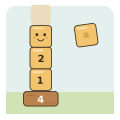
The wooden stand shows a number and the tower shows that many empty spots. Your child taps a block in the tray, or drags it, and it glides onto the tower while the voice counts: one, two, three. The next block can only go on once the count has been said, so every block is one number. The tower's top block has a little face that rides up as it grows. A round is 5 towers, then it stops.
Child lock: tap the lock at the top right. The ways out hide and the back button stays in the game. To unlock, tap the lock and answer a sum.
Easy (ages 2 to 3): towers of 1 to 5. Normal (age 4): towers of 3 to 10. Hard (5 and up): 11 to 20. A ten already stands on its own stand, your child adds the ones, the count goes on from ten, and the cards above show it as 10 + 7 = 17.
Why it's good for your child, what they learn, and how we designed it
Free, no ads, no sign-in. We count plays without names or anything that identifies your child, and your child is never recorded. Every picture is drawn in code.
Why it's good for your child
Counting real things, one for each number word, is the base of early math, and early math skills at school entry predict later school success more strongly than early reading or attention (Duncan 2007). Building a tower makes each number something your child can see grow: five is five blocks tall. The line on the "All done" screen takes it to real blocks on the floor, where talking together helps most (AAP, Zero to Three).
What they learn
Counting from 1 to 10 by building, one block with each number word, and knowing the last number said is how many there are in all. The top level builds 11 to 20 as a ten and some more, the start of place value. These are kindergarten standards K.CC.B.4 (one number for each thing, the last number tells how many), K.CC.B.5 (count up to 20 things) and K.NBT.A.1 (numbers 11 to 19 are ten ones and some more ones).
How we designed it for ages 3 to 6
Each tap adds one block in one slow glide, and the voice counts it before the next block can go, so tapping fast never runs ahead of the counting, and tapping works for hands too small for precise dragging (Hiniker 2015). Nothing races or loops, because fast-paced cartoons lowered 4-year-olds' attention right after (Lillard & Peterson 2011), and one clear voice speaks with no background music (Bus, Takacs & Kegel 2015). A round stops after 5 towers on "All done", with nothing to collect and no "one more" prompt (Radesky 2022).
About the game
Block Towers is a free counting game for preschoolers and kindergartners, made like a set of wooden counting blocks. The stand says how many, the tower shows that many empty spots, and your child fills it one block at a time while the voice counts out loud. Each tower is topped by one of ten block pals, each with its own face and a little leaf, acorn or flower on top.
Three levels, set by age
- Easy (ages 2 and 3): "Let's build three." Towers of 1 to 5 blocks.
- Normal (age 4): towers of 3 to 10 blocks, counting to 10.
- Hard (age 5 and up): "Let's build seventeen. Ten and seven more." A ten stands ready, your child adds the ones, and the count goes on: eleven, twelve, all the way to seventeen.
How a round goes
A round is 5 towers, then "All done" shows them lined up with a line for you to talk about together. Before you hand over the phone, tap the lock at the top right. More: how we build calm games, questions parents ask.
Questions parents ask
Is Block Towers free?
Yes. There is no sign-in, nothing to download and nothing to buy inside the game. It runs in the web browser on phones, tablets and computers.
Can my child tap fast to finish a tower?
No. Each block is counted out loud as it lands, and the next block can only go on once that number has been said, so every block is one count.
How long is a round?
5 towers, then the game stops on an All done screen with the towers lined up and a line for you to talk about together. Nothing starts by itself.
All done!
You built five towers.
Grown-up: